
Introduction
Most enterprise teams do not lose control of their AI delivery pipeline in one dramatic moment. They lose it incrementally, one unapproved output at a time.
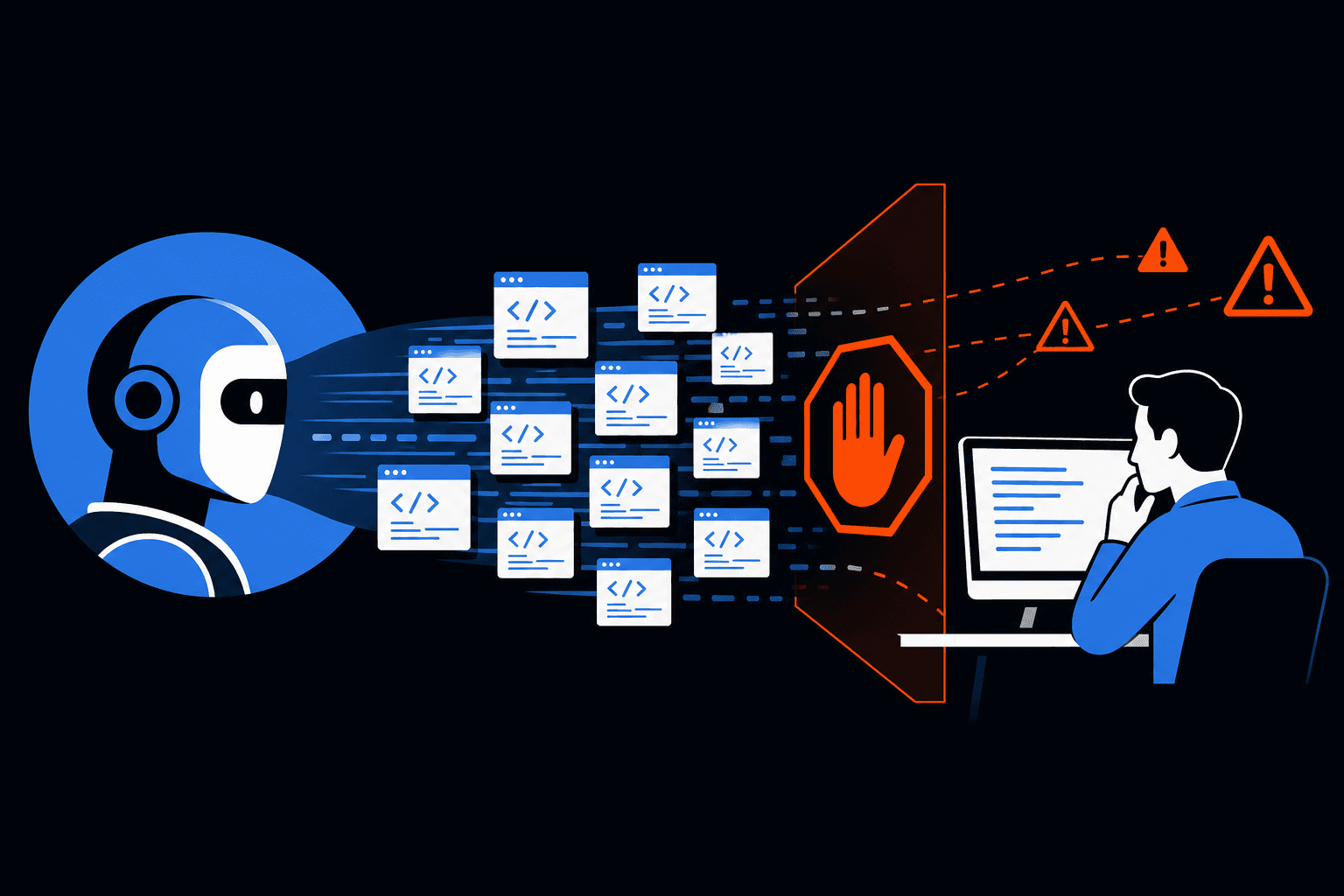
AI code review has moved from a best-practice recommendation to a structural necessity. As agentic coding tools push output volume to levels no human sprint cycle was designed to absorb, the gap between what gets generated and what gets properly reviewed keeps widening. That gap is where compliance exposure lives. It is where security vulnerabilities get buried. And it is where board-level accountability lands - on you.
The volume problem is already here
Agentic coding tools have changed the arithmetic of software delivery. A single AI agent can generate pull requests at a pace that would take a mid-sized engineering squad weeks to produce manually. That is the value proposition.
But speed without corresponding review capacity does not accelerate delivery. It accelerates risk accumulation.
The market has already priced this in. Anthropic launched Claude Code Review specifically to address the bottleneck that emerges when AI-generated code outpaces human oversight. Qodo closed a $70 million Series B in 2026 with a thesis built almost entirely around the same problem: agentic output volume has exceeded the review infrastructure most enterprises have in place. When two well-capitalized companies target the same gap within months of each other, that gap is not theoretical - it is a live, urgent enterprise pain point.
The question is not whether your agents are producing more than your reviewers can handle. The question is what is slipping through.
AI-generated code is not automatically safe code
There is a persistent assumption in enterprise AI rollouts that because an agent follows instructions precisely, its output is inherently more reliable than human-written code. Security researchers have pushed back on this directly.
Dark Reading has made the point clearly: AI-generated code should be treated as potentially vulnerable and reviewed with the same scrutiny applied to any human-authored contribution. Agents do not introduce malicious intent, but they do introduce the same vulnerability classes human developers introduce - insecure defaults, improper input validation, dependency risks, logic errors that only surface under specific conditions. They introduce them at higher volume and with greater consistency, which makes the pattern harder to catch in a standard review.
An agent generating 40 pull requests a week with a flawed pattern will embed that flaw 40 times before anyone flags it. A developer doing the same thing generates the problem once and gets caught in the next standup.
Volume amplifies both capability and error. That is not a criticism of agentic tools - it is a structural reality your review process has to account for.
Why standard AI code review approaches fall short
Most enterprise teams responding to this problem reach for one of two solutions. Neither is sufficient on its own.
- The first is layering on more automated checks: SAST tools, dependency scanners, linting pipelines. These catch known vulnerability patterns. They do not catch architectural decisions that violate your compliance posture, test coverage gaps an agent glossed over, or integration behavior that looks correct in isolation but breaks under production load.
- The second is assigning a human reviewer to every agent-generated PR. This works until the volume makes it untenable. When agents run 24 hours a day and your senior engineers do not, the queue grows faster than it clears. Teams start rubber-stamping. The review process becomes a formality rather than a gate.
Neither approach separates code generation from code approval by design. They bolt oversight onto a pipeline that was never structured for it. That is the gap.
Separation of duties is not a new concept - it just needs to apply to agents
In financial services, separation of duties is a foundational control. The person who initiates a transaction cannot be the same person who approves it. The logic is simple: approval by the same actor who generated the output is not approval - it is confirmation bias with extra steps.
The same logic applies to AI-generated code. An agent that generates a feature and then runs its own test suite is not providing independent validation. It is checking its own work. The test coverage may be real, but the judgment about whether that coverage is adequate, whether the integration meets your security requirements, whether the output matches what the product team actually approved - that judgment requires a different actor.
This is not a philosophical point. It is an audit point. In regulated industries - financial services, aviation, insurance, telecom - the question "who approved this before it shipped?" needs a human answer. "The agent passed its own tests" does not satisfy a regulator or hold up in a post-incident review.
What a properly structured agentic delivery model looks like
Agentic, not autonomous. That distinction matters more than any feature list.
At Tmob AI Studio, the delivery model is built around this separation by design, not as an add-on. AI agents handle the volume: Design Engineer agents, Product Engineer agents, and Test Engineer agents work around the clock, generating code and self-correcting until every automated check passes. That is the generation layer.
The approval layer is separate and human. A named senior Tmob AI Studio expert reviews integration, test coverage, and security alignment before anything ships. That expert signs off at the release gate. Nothing deploys on an agent's say-so alone.
The client reviews a running build in a Customer Portal before sign-off. The code goes directly into the client's own repository - owned from day one, on a standard exportable stack, with no vendor lock-in.
Human oversight here is not optional or asynchronous. It is structural. The release gate does not open without a named human signature. That is the control that makes agentic delivery auditable.
The real risk is organizational, not technical
Enterprise teams often frame the AI code review problem as a tooling problem. Get the right scanner, the right linting config, the right automated test framework. That framing misses the root cause.
The root cause is that agentic output volume has outpaced the organizational structures built to govern it. Tools catch vulnerability patterns. They cannot make judgment calls about business logic, compliance alignment, or whether the output matches the approved product specification. Those calls require human accountability.
When an incident happens - and in production systems at scale, incidents happen - the question is not which tool failed to catch it. The question is which human was accountable for approving it. If the answer is "no one specifically," that is a governance failure, not a tooling failure.
The teams that scale agentic delivery successfully treat this as an organizational design question from the start. Who approves? What do they review? What is the standard for sign-off? Those questions need answers before agents go into production, not after the first incident.
What to do now
If your organization is running AI agents in the delivery pipeline and your current review process is a combination of automated checks and ad hoc human review, you have a gap. The right time to close it is before a regulated audit or a production incident makes it urgent.
The architecture is straightforward: separate generation from approval, make the approval role explicit and named, and ensure the review covers integration, test coverage, and security alignment - not just syntax and known vulnerability patterns.
To see how a managed agentic delivery engagement handles this by design, start at tmobstudio.ai.