
Introduction
Most enterprises deploying AI agents in 2026 have the speed problem solved. The problem they have not solved is accountability. AI governance - who is responsible when an agent ships something wrong - remains the open question that boards, regulators, and engineering leaders are circling without a clean answer.
Agents move fast. They generate code, run tests, and push artifacts around the clock without fatigue. That velocity is real and valuable. But velocity without a defined accountability structure is not delivery. It is exposure.
The gap between deployment intent and governance readiness
Enterprises are moving quickly into agentic AI. Deloitte's 2026 survey found that 74% of enterprises plan agentic AI deployment within two years, but only 21% have mature governance frameworks in place to support it. That is not a small gap. It is a structural mismatch between ambition and operational readiness.
IBM's research published in June 2026 puts a sharper edge on it: two-thirds of technology executives report being responsible for AI systems they do not fully understand or control, and only 11% feel ready for agent-scale deployment.
These numbers describe a specific failure mode. Organizations are not failing to adopt AI. They are adopting it faster than they can answer the question: who signs off?
What "autonomous" actually means in production
The word autonomous sounds like a feature. In a regulated enterprise environment, it is a liability.
An autonomous system makes decisions and acts on them without requiring human approval at each step. That works for narrow, well-bounded tasks with low consequence. It becomes a governance problem the moment the output touches production code, customer data, financial logic, or any system a regulator can audit.
The EU AI Act provisions that came into force in August 2026 are explicit on this point. High-risk AI systems - those operating in financial services, critical infrastructure, employment, and similar domains - require meaningful human oversight before consequential outputs are acted upon. "Meaningful" is the operative word. A log that a human could theoretically review is not the same as a named person who reviewed it and approved it.
Most agentic delivery setups do not have that named person. They have dashboards.
Why the sign-off gate is not just a compliance checkbox
There is a tendency to frame human oversight as a regulatory burden - something you add to satisfy an auditor. That framing misses the operational value.
A proper sign-off gate does four things no agent can do for itself.
- It catches context drift. Agents optimize against the spec they were given. They do not know the spec was written before the client's regulatory environment changed last quarter, or that an integration partner updated their API contract two weeks ago. A senior engineer reviewing the release does.
- It creates a clear accountability chain. When something goes wrong in production - and in enterprise systems, something always eventually does - the question is not "which agent made this decision?" It is "which human approved this release?" Without a named sign-off, that question has no answer. That is not a technical problem. It is a governance failure.
- It separates generation from approval. The agent that builds the code cannot be the same entity that approves it for production. That separation of duties is foundational in financial controls, security auditing, and regulated software delivery. Collapsing it because agents are fast does not make the risk disappear. It makes it invisible.
- It makes the audit trail defensible. A record showing that a named senior expert reviewed integration, test coverage, security posture, and production readiness before each release holds up in a board review, a regulatory inquiry, or a post-incident analysis. A record showing that an agent self-approved does not.
Where agentic delivery fits and where it does not
The right framing for AI agents in software delivery is agentic, not autonomous. That distinction matters more than it might appear.
Agentic means the AI carries the volume: design work, code generation, test execution, self-correction. It operates continuously, handles the parallelism that human squads cannot sustain, and produces artifacts at a pace no traditional team can match. That is the genuine value of agentic delivery.
What it does not mean is that the agent decides what ships.
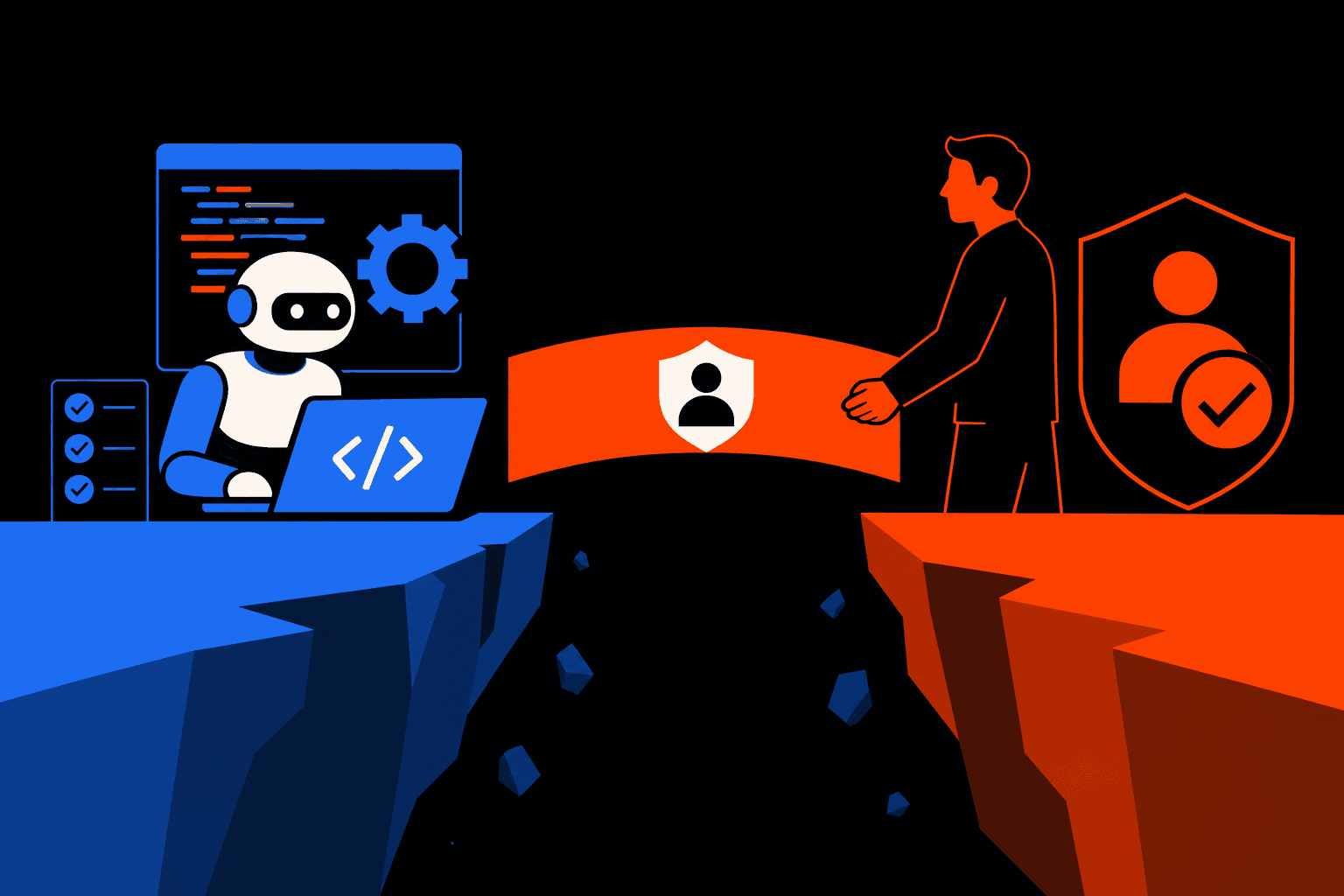
The decision to release sits with a named human expert who has reviewed the full release state - integration health, test coverage, security findings, and production readiness. The agent produces. The human approves. That separation is not a concession to risk aversion. It is the design.
What a real sign-off gate looks like in practice
At Tmob AI Studio, every engagement runs a five-stage delivery loop. AI agents handle design, product, and testing work continuously. A named senior Tmob expert holds the release gate at every stage before anything moves to production.
That means a specific person reviews the integration state, confirms test coverage is complete, checks security posture, and signs off on production readiness. Not a dashboard. Not a summary report. A named expert who is accountable for that release.
The client reviews a running build in a Customer Portal before sign-off - not a slide deck or a status update. Feedback from that review goes back into the loop. Nothing ships until both the client and the named expert have cleared it.
The delivered code lands in the client's own cloud environment. The client owns it from day one, on a standard exportable stack, with no dependency on Tmob AI Studio's infrastructure to keep it running. That is not a licensing arrangement. That is a clean handover.
This model has supported delivery for enterprises including Mastercard, Vodafone, Turkish Airlines, and Shell - organizations where a production failure carries regulatory, reputational, and operational consequences that cannot be absorbed by pointing at an agent.
The question every CTO should be asking right now
If your organization is running AI agents in or near production, one question determines whether your AI governance posture is real or theoretical: who is the named person who signed off on the last release, and what did they review?
If the answer is a process, a tool, or a team rather than a specific person with a documented review, you have the accountability gap. It may not have caused a problem yet. That is not the same as not having it.
AI governance in 2026 is not about slowing down agentic delivery. It is about making sure that when delivery moves at agent speed, the accountability structure keeps pace. Speed without sign-off is not an advantage. It is deferred risk.
Learn more about how Tmob AI Studio structures agentic delivery with named human oversight at tmobstudio.ai.