
Introduction
Most product briefs were designed for human readers. A product manager would write one, a tech lead would interpret it, and a squad would fill in the gaps through conversation. That worked when the gaps were filled by people who could ask questions.
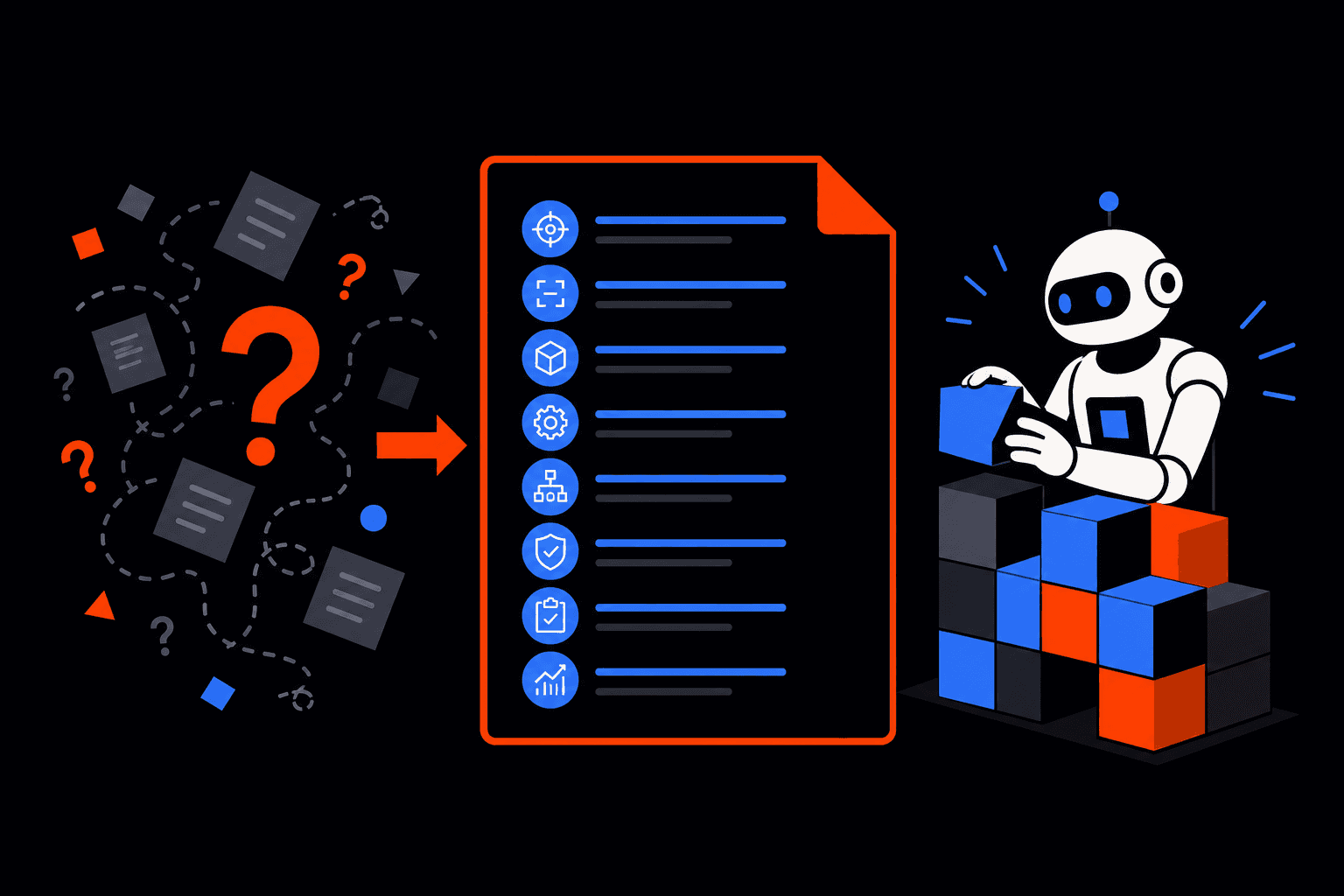
AI agent delivery teams do not fill gaps through conversation. They execute on what the brief contains. When the brief is incomplete, agents make assumptions. When those assumptions compound across design, build, and test, the delivered product drifts from what was approved. By the time a release gate catches it, the rework cost is real.
This article gives you a product brief template built specifically for AI agent delivery teams, explains what each section does mechanically, and shows how a well-structured brief connects to faster, more auditable delivery.
Why standard product briefs fail AI agent teams
A traditional brief leaves room for interpretation. That room is intentional. Human engineers ask clarifying questions during sprint planning, designers infer intent from mood boards, and QA teams negotiate acceptance criteria in real time.
AI agents do not negotiate. An AI Product Manager agent reads the brief and generates a spec. A Design Engineer agent reads that spec and produces wireframes. A Product Engineer agent reads those wireframes and writes code. Each stage amplifies whatever ambiguity entered at the top.
The failure mode is not that agents are incapable. It is that agents are precise about the wrong thing when the source material is vague. A brief that says "users should be able to manage their account" will produce a feature - it will not necessarily produce the feature the VP of Product had in mind.
Three specific gaps cause most of the problems:
- Missing scope boundaries. The brief describes what the product should do but not what it explicitly should not do. Agents interpret silence as permission.
- Absent acceptance criteria. Without defined conditions for "done," test agents have no target. Coverage runs high but against the wrong surface.
- Unresolved constraint conflicts. When a brief lists both a hard deadline and a feature set that cannot realistically fit it, agents do not flag the conflict. They attempt to satisfy both.
A brief built for AI agent delivery resolves these gaps before the first agent reads it.
The product brief template
This template is structured for AI-agent-driven delivery. Each section maps to a stage in the delivery loop: brief, spec, build, test, or sign-off. Nothing is decorative.
Section 1: Product context
What to write: One paragraph, three to five sentences. State the business problem, the user it affects, and why it matters now.
Why it matters for agents: The AI Product Manager agent uses this section to scope the spec. Vague context produces an over-scoped spec. Specific context produces a spec that matches the actual problem.
What to include:
- The business problem in plain terms
- The user segment affected - not a persona name, an actual description
- The trigger for building this now (regulatory deadline, competitive pressure, operational failure)
- The metric that will move if this works
Example: Our corporate travel booking flow requires manual approval for any booking over £2,000. Finance teams process 400-600 of these per week. The manual step adds 48-72 hours to booking confirmation and causes 15-20 percent of bookings to be abandoned before approval completes. We need an automated approval routing layer that reduces confirmation time to under four hours for 90 percent of bookings.
That paragraph tells an AI Product Manager agent exactly what to scope, what to exclude, and what "done" looks like in business terms.
Section 2: Scope definition
What to write: Two lists. What is in scope. What is explicitly out of scope.
Why it matters for agents: This is the most important section for controlling agent behavior. Agents do not have a natural stopping point. They will build adjacent features if the brief does not define the boundary.
In-scope list format:
- One line per capability
- Written as user-facing outcomes, not technical tasks
- Numbered, not bulleted (sequence matters for prioritization)
Out-of-scope list format:
- Explicit statements of what will not be built in this engagement
- Include anything a reasonable agent might assume is included
Example out-of-scope entries:
- Integration with legacy HR system (separate engagement)
- Mobile app version (web only for this phase)
- Multi-currency support (GBP only)
- Admin reporting dashboard (post-launch backlog item)
Explicit out-of-scope entries prevent the most common form of scope creep in agentic delivery: agents building things no one asked for because no one said not to.
Section 3: Functional requirements
What to write: A structured list of what the product must do, organized by user journey stage.
Why it matters for agents: The Solution Analyst agent converts this section into the technical spec. Vague requirements produce a spec that requires interpretation. Specific requirements produce a spec that can be directly tested.
Format:
- Group requirements by user journey stage, not by feature category
- Write each requirement as: [Actor] [action] [object] [condition]
- Include the edge case in the requirement itself, not as a footnote
Example:
Approver receives an email notification within 15 minutes of a booking request being submitted. The notification includes booking details, requester name, cost center, and a single-click approve/reject link that remains valid for 72 hours.
That requirement tells the Product Engineer agent what to build, tells the Test Engineer agent what to test, and tells the Design Engineer agent what the notification UI needs to contain.
For teams building their first AI-agent-delivered product, the guide on how to build a product spec with AI walks through translating requirements into a machine-readable spec in more detail.
Section 4: Non-functional requirements
What to write: Explicit constraints on performance, security, compliance, and integration.
Why it matters for agents: Non-functional requirements are the most commonly omitted section in standard briefs. When agents do not have them, they make default choices. Default choices are rarely wrong - but they are rarely auditable.
Include:
- Performance targets (response time, throughput, availability SLA)
- Security requirements (authentication method, data classification, access control model)
- Compliance constraints (GDPR, PCI-DSS, SOC 2 alignment, sector-specific regulation)
- Integration dependencies (named systems, API versions, data formats)
- Deployment environment (cloud provider, region, containerization requirements)
Example:
All booking data is classified as confidential. PII must not be stored in application logs. The approval routing service must be deployable to the client's existing Azure environment. Authentication must use the existing Azure AD tenant. Response time for the approval API must be under 500ms at the 95th percentile under normal load.
These constraints feed directly into the Test Engineer agent's test plan. Without them, test coverage may be high - but not necessarily against the requirements that matter for compliance or production readiness.
Section 5: Acceptance criteria
What to write: A numbered list of conditions that must be true for the product to be considered complete.
Why it matters for agents: Acceptance criteria are the target the Test Engineer agent runs against. They are also the reference the human sign-off gate uses to approve a release. Without them, the test phase produces coverage, not confidence.
Format:
- Write each criterion as a testable statement
- Use "Given / When / Then" structure where behavior is conditional
- Include both functional and non-functional criteria
Example:
Given a booking request over £2,000 is submitted, when the approver clicks the approve link in the notification email, then the booking status updates to "approved" within 30 seconds and the requester receives a confirmation email.
Five to ten well-written acceptance criteria produce a more reliable release than 50 vague ones. The Test Engineer agent runs against all of them. The named human who signs off at the release gate reviews them before production release.
Section 6: User stories (optional but recommended)
What to write: Three to eight user stories covering the primary user journeys.
Why it matters for agents: User stories give the AI Product Manager agent a structured view of user intent that supplements the functional requirements. They are particularly useful when the product involves multiple user types with different permissions or workflows.
For teams that want to generate user stories before writing the brief, the guide on generating user stories with AI covers the process from persona to story to acceptance criteria.
Section 7: Constraints and dependencies
What to write: A list of hard constraints the delivery team cannot change, and external dependencies that could affect the timeline.
Why it matters for agents: Constraints are not requirements. They are facts about the world the delivery must operate within. Agents that do not know a constraint exists will design around it incorrectly.
Include:
- Hard deadlines and the reason they are hard (regulatory, contractual, board-committed)
- Budget ceiling if it affects scope decisions
- External system dependencies and their current stability
- Organizational constraints (approval processes, procurement lead times, change freeze windows)
- Data availability (what data exists, what format it is in, who owns it)
A brief that lists a hard regulatory deadline alongside the feature set it requires gives the delivery team the information needed to flag a conflict before build starts - not during test.
Section 8: Definition of done
What to write: A single paragraph or short list defining what "production-ready" means for this specific product.
Why it matters for agents: This section is the release gate reference. The named human who signs off at production release checks the delivered product against this definition. Without it, "done" is ambiguous and the sign-off gate has no clear standard to apply.
Include:
- Test coverage threshold
- Performance benchmarks met in staging
- Security review completed
- Stakeholder sign-off on the Customer Portal review
- Deployment environment confirmed
How this brief maps to the delivery loop
A brief structured this way does not just help agents. It maps directly to each stage of the delivery loop.
Onboarding: The product context, scope definition, and constraints sections give the AI Product Manager agent enough material to produce a spec, SLA, and delivery date within 24 hours. Gaps in these sections are the primary cause of onboarding delays.
Build: The functional requirements and non-functional requirements sections drive the Design Engineer and Product Engineer agents. Specific requirements produce specific code. Vague requirements produce rework.
Test: The acceptance criteria and definition of done sections define the test surface. Test Engineer agents run 24/7 against these criteria. When they are well-written, the test phase converges. When they are absent, it cycles.
Feedback: The Customer Portal review cycle is faster when the client can compare the running build against the acceptance criteria they wrote. The brief becomes the review reference, not just the starting document.
Sign-off: The definition of done is the release gate standard. The named human who signs off at production release checks the delivered product against what the brief committed to. That check is only meaningful if the brief was specific.
For teams building a more detailed product requirements document alongside the brief, the guide on writing a PRD with AI in 2026 covers the transition from brief to full spec.
Common brief mistakes that stall AI agent delivery
Writing outcomes without constraints. "The system should be fast" is not a requirement. "API response time under 300ms at the 95th percentile" is. Agents will satisfy the first statement with any implementation. They will satisfy the second with a specific one.
Listing features instead of user journeys. Feature lists produce feature coverage. User journey requirements produce products that work end to end. AI agents are good at building features. They need the brief to tell them how those features connect.
Omitting the out-of-scope list. This is the single most common omission - and the one that causes the most rework. Write it even when it feels obvious.
Conflating requirements with implementation decisions. The brief should say what the product must do, not how it should be built. Implementation decisions belong in the spec. When the brief specifies implementation, it constrains the Solution Analyst agent unnecessarily and often incorrectly.
Setting a deadline without a scope trade-off decision. If the deadline is fixed, the scope must be flexible. If the scope is fixed, the deadline must be flexible. A brief that fixes both without acknowledging the conflict forces agents to make that trade-off silently. That decision should be made by a person.
Brief quality and product roadmap alignment
A well-structured brief does more than start a delivery engagement. It creates a traceable record of what was approved at the point of commissioning.
That record matters when the delivered product is reviewed against the original intent, when a compliance audit asks what was scoped and when, and when the next phase needs to be prioritized against what the first phase actually delivered.
Teams that treat the brief as a living artifact - updated through the feedback cycle and referenced at each release gate - produce roadmaps that reflect actual delivery history rather than aspirational planning. The connection between brief quality and roadmap reliability is direct. The article on what a product roadmap is and how AI changes the way teams build them covers that relationship in detail.
What to do with the brief once it is written
Submit it.
A well-structured brief is the input that makes AI-agent delivery work. It is also what makes the 24-hour proposal SLA possible.
A brief submitted through tmobstudio.ai returns a scoped, costed proposal within one business day - no commitment required. The proposal includes a delivery spec, SLA, and delivery date based on what the brief contains. The quality of the proposal reflects the quality of the brief.
If the brief is incomplete, the onboarding stage surfaces the gaps before build starts. That is a structural feature of the delivery model. But briefs that arrive complete move faster through onboarding, produce more accurate specs, and reach the build stage with fewer clarification cycles.
The template above is the starting point. The brief you write from it is the contract between what you approved and what gets shipped.