
Introduction
Most enterprise app development projects do not fail because the engineering team lacked skill. They fail because the delivery model cannot keep pace with the scope, the governance requirements, or the accountability expectations that come with building software at enterprise scale.
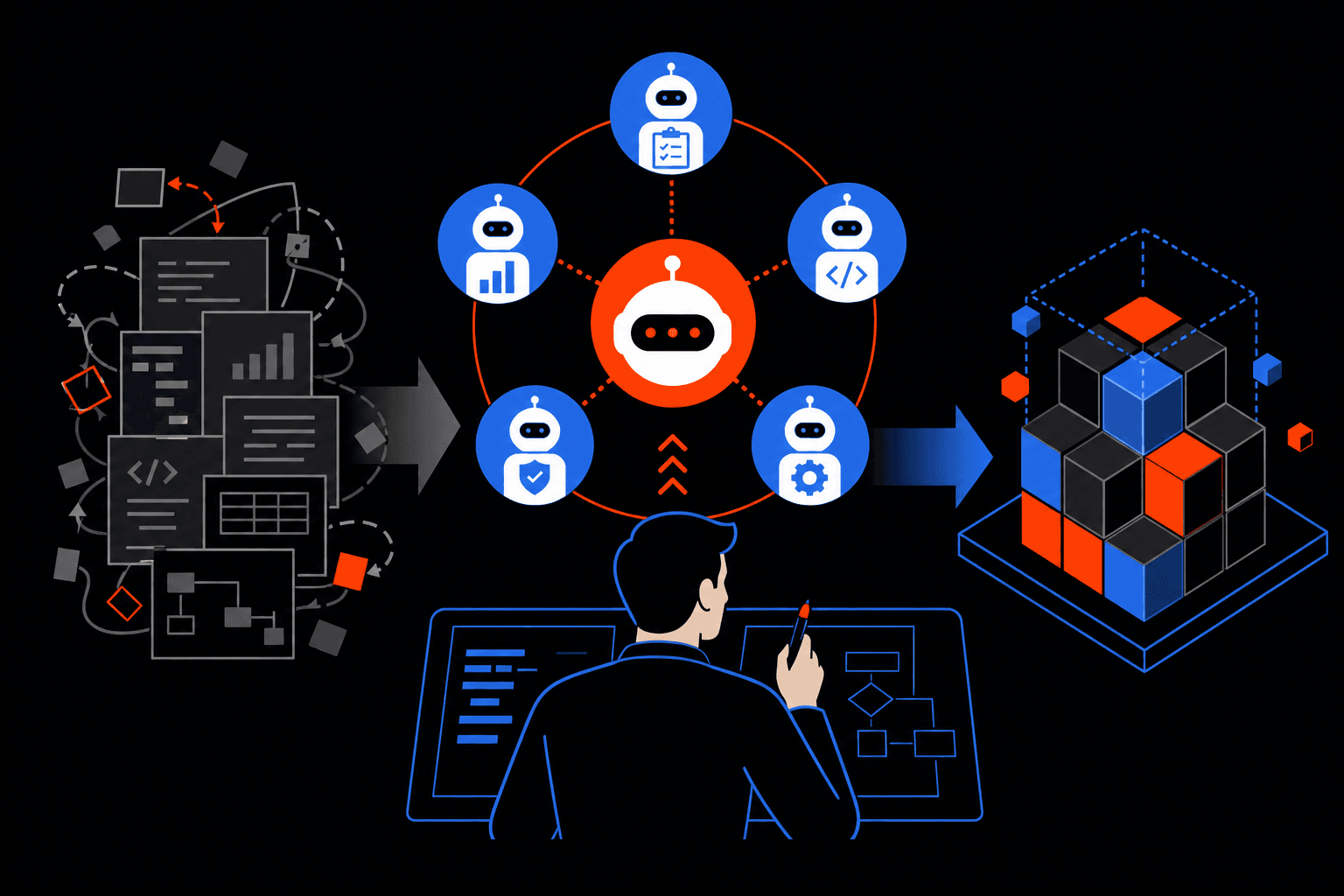
AI agents are changing that equation - not by replacing engineers, but by running the high-volume, repetitive work around the clock so that human judgment can focus on the decisions that actually matter: architecture, sign-off, and production readiness.
This guide covers what enterprise app development looks like when AI agents are part of the delivery pipeline, where the real risks sit, and what a well-structured agentic delivery model needs to include before any code reaches production.
What enterprise app development actually involves
Enterprise app development is the process of designing, building, testing, and deploying software applications that operate at organizational scale. These are not consumer apps. They integrate with existing systems, carry compliance obligations, serve thousands of internal or external users, and need to perform reliably under load.
The scope is categorically different from a startup build. An enterprise application typically connects to identity management, internal data warehouses, third-party APIs, and compliance tooling. It needs to pass security review. It needs an audit trail. It needs to be maintainable by teams who had no part in the original build.
That complexity is exactly where traditional delivery models start to break down.
Where traditional delivery slows down
Large consulting engagements front-load weeks of scoping before a line of code is written. Internal teams get pulled across competing priorities. Sprint velocity drops as integration complexity grows. The product that ships in month six looks meaningfully different from the product that got approved in month one.
That gap between what was approved and what shipped is not a communication failure. It is a structural problem in how most enterprise software delivery is organized.
How AI agents change the delivery model
AI agents do not replace the delivery process. They operate inside it, handling the tasks that consume the most time without requiring the most judgment.
In a well-designed agentic delivery pipeline, agents handle design generation, code production, and test execution continuously. They work in the client's own repository, produce pull requests, and run test suites until every check passes. They do not stop at the end of a working day.
The result is a build loop that runs 24/7 without the coordination overhead that slows human-only teams. Work that previously required a full sprint can move faster. Rework cycles that stalled on availability get resolved in hours, not days.
This is not the same as autonomous code generation. An agent that writes code without human oversight creates a different problem: output that no one has verified, architecture decisions no one has approved, and a production environment that no senior engineer has signed off on.
That distinction matters. Agentic delivery is not autonomous delivery.
The five roles that make agentic delivery work
A functional agentic delivery model requires more than a single coding agent. Building an enterprise application spans product thinking, design, engineering, and quality assurance - and each of those disciplines needs a corresponding agent role.
Tmob AI Studio operates five named agent roles in its delivery pipeline:
- AI Product Manager handles requirements translation and backlog management
- Solution Analyst maps business logic and integration requirements
- Design Engineer produces interface and architecture artifacts
- Product Engineer writes and commits code into the client's own repository
- Test Engineer runs test suites continuously until every check is green
These roles do not operate in isolation. They run as a coordinated loop, with each agent's output feeding the next stage. That coordination is what multi-agent orchestration for software delivery looks like in practice - and it is meaningfully different from a single agent generating code on demand.
The governance layer that enterprise delivery requires
This is where most agentic delivery discussions go quiet. Agents can produce code at volume. That does not mean the code is ready for production.
Enterprise applications carry real compliance obligations. Financial services software needs an audit trail. Aviation systems need security review. Telecoms platforms need integration testing against live infrastructure. A governance model that relies on the agent to self-certify is not a governance model.
A Deloitte 2026 study found that 74% of enterprises plan agentic AI deployment within two years, but only 21% have mature governance in place. That gap is not a technology problem. It is a structural problem in how agentic delivery is being set up.
The governance requirement is a named human with accountability at every release gate. Not a review policy. Not an automated quality check. A specific person who has examined the integration, the test coverage, the security posture, and the production readiness - and signed off before anything ships.
At Tmob AI Studio, that person is the Producer. Every engagement has a named Producer who owns accountability end to end. Nothing reaches production without their sign-off. That is a structural mechanism, not a process document.
What the delivery loop looks like in practice
Knowing the stages of a well-run agentic enterprise build clarifies where the speed gains come from - and where human judgment stays in place.
Stage 1: Onboarding
The client submits a brief or RFP. Within 24 hours, they receive a scoped, costed delivery plan with an SLA and a delivery date. No weeks of discovery. No commitment required to receive the plan.
Stage 2: Build
Design Engineer and Product Engineer agents begin working in the client's own repository. Every commit is client-owned from the first line. The stack is standard and exportable. There is no vendor lock-in built into the architecture.
Stage 3: Test
Test Engineer agents run continuously until every check passes. They do not wait for a scheduled QA sprint. They self-correct and rerun until the build is green.
Stage 4: Feedback
The client reviews a running build in a Customer Portal. Their input feeds directly into the next build cycle. This is not a static demo - it is a live product the client can interrogate and respond to.
Stage 5: Sign-off and live
The Producer reviews the integration, test coverage, security posture, and production readiness. Sign-off is required before deployment. The product deploys into the client's own cloud environment. The client owns the code. Tmob AI Studio does not retain access or control after delivery.
Enterprise integrations and compliance requirements
Enterprise app development does not happen in a clean environment. The new application needs to connect to the systems the organization already runs.
Tmob AI Studio supports integrations with Jira, GitHub, GitLab, Azure DevOps, ServiceNow, and Datadog - the toolchain components that enterprise engineering teams already operate. The delivery pipeline works inside that existing infrastructure, not alongside it.
On compliance, the service operates to SOC 2, ISO 27001, and GDPR standards. A full audit trail is maintained throughout delivery. Client data stays inside the client's own boundary and is never used for model training. That last point is not a policy preference - it is a hard architectural constraint.
For teams working in regulated industries, the AI governance control plane question is not optional. The EU AI Act and expanding federal guidance make uncontrolled AI delivery a legal exposure, not just a quality concern.
New builds versus legacy modernization
Enterprise app development is not always a greenfield project. Many enterprises carry legacy systems that are too embedded to replace outright but too fragile to extend. The delivery model needs to handle both.
For new system builds, the brief-to-production pipeline applies directly. The client submits a brief, agents begin building, and the Producer signs off before go-live.
For legacy modernization, Tmob AI Studio uses a strangler-fig incremental cutover approach. Business logic is recovered into a reviewed spec with characterization tests before any rebuilding begins. The existing system keeps running. The new system replaces it incrementally - no forced cutover that freezes the business.
That distinction matters for enterprise buyers who cannot afford a big-bang migration. The delivery model needs to match the operational reality, not the other way around.
How this compares to other delivery approaches
Enterprise technology leaders evaluating agentic delivery have three broad options: pure autonomous coding agents, consulting-led firms with AI tools layered on top, or a managed agentic delivery service.
Pure autonomous coding agents like Factory.ai and Devin (Cognition) are tools for engineering teams that already have established workflows. They require the client to manage scoping, architecture decisions, and deployment orchestration. There is no brief-to-production pipeline and no human sign-off at release gates.
Consulting-led firms use human teams with AI tools. Delivery quality depends on the team assigned. Scoping cycles are long. Overhead is high before any build starts.
A managed agentic delivery service combines agent throughput with human accountability. The agents handle volume. The Producer handles sign-off. The client receives a running product - not a tool to operate or a team to manage.
The structural difference is not speed. It is accountability. How enterprise teams use AI to accelerate release cycles without sacrificing quality depends on having that accountability layer in place before the agents start building.
What to look for when evaluating an agentic delivery partner
Not every agentic delivery service is structured the same way. Before committing to an engagement, these are the questions that matter:
1. Who signs off before code reaches production, and are they named?
2. Does the client own the code from the first commit, or does ownership transfer at delivery?
3. Can the stack run independently of the vendor after delivery?
4. How does client data interact with the vendor's training infrastructure?
5. What happens to the audit trail if the engagement ends?
6. Does the vendor handle scoping, or does the client need internal capacity to define the spec?
7. What compliance standards govern the delivery process?
These questions separate a delivery service from a tool. They also separate a vendor that builds accountability into its architecture from one that treats governance as a policy document.
Strong AI-powered product documentation is one signal that a delivery partner takes specification and traceability seriously. It is not sufficient on its own - but its absence is a reliable warning sign.
The credibility question
Enterprise buyers in finance, aviation, telecoms, and retail are not running pilot experiments. They are making production decisions that carry regulatory, reputational, and operational consequences.
Tmob AI Studio is built on 17 years of enterprise software delivery and more than 300 projects shipped. The products delivered for clients serve more than 250 million daily users. That track record is not a marketing claim - it is the foundation every engagement runs on.
Getting started
Enterprise app development with AI agents is not a technology bet. It is a delivery model decision. The agents provide throughput. The governance structure provides accountability. Together, they are what makes production-grade outcomes possible at enterprise scale.
If you are evaluating how agentic delivery could work for your next build or modernization program, Tmob AI Studio returns a costed proposal within one business day of receiving a brief. No commitment required. Start at tmobstudio.ai.