
Introduction
Most enterprises entering an AI development engagement have a budget figure in mind and almost no framework for what that figure should actually cover. AI development cost in 2026 is not a single number - it is a stack of decisions, each with its own pricing logic, risk surface, and long-tail consequence. Get the framing wrong at the start and you will spend the right amount on the wrong thing.
This article breaks down what enterprise AI development actually costs, where the hidden spend accumulates, and how to evaluate whether what you are paying is buying what you think it is.
Why AI development cost is so hard to benchmark
The market has no standard unit of measure. A $150,000 engagement at one firm might deliver a working prototype in a sandbox. The same figure at another firm might deliver a production-deployed system with full test coverage and a compliance audit trail. Both call it "AI development."
Pricing opacity makes this worse. Of the major enterprise AI delivery firms operating in 2026, six out of seven do not publish pricing at all. The one exception, Clean Coders Studio, publishes tiered pay-per-feature pricing from under $50,000 to $150,000 and above - which at least gives buyers a reference point for human-staffed delivery. But that model is entirely human-staffed, so throughput is bounded by headcount, and the pricing logic does not translate to agentic delivery.
The result: buyers go into vendor conversations without a defensible baseline, and vendors quote against whatever the buyer reveals about their budget.
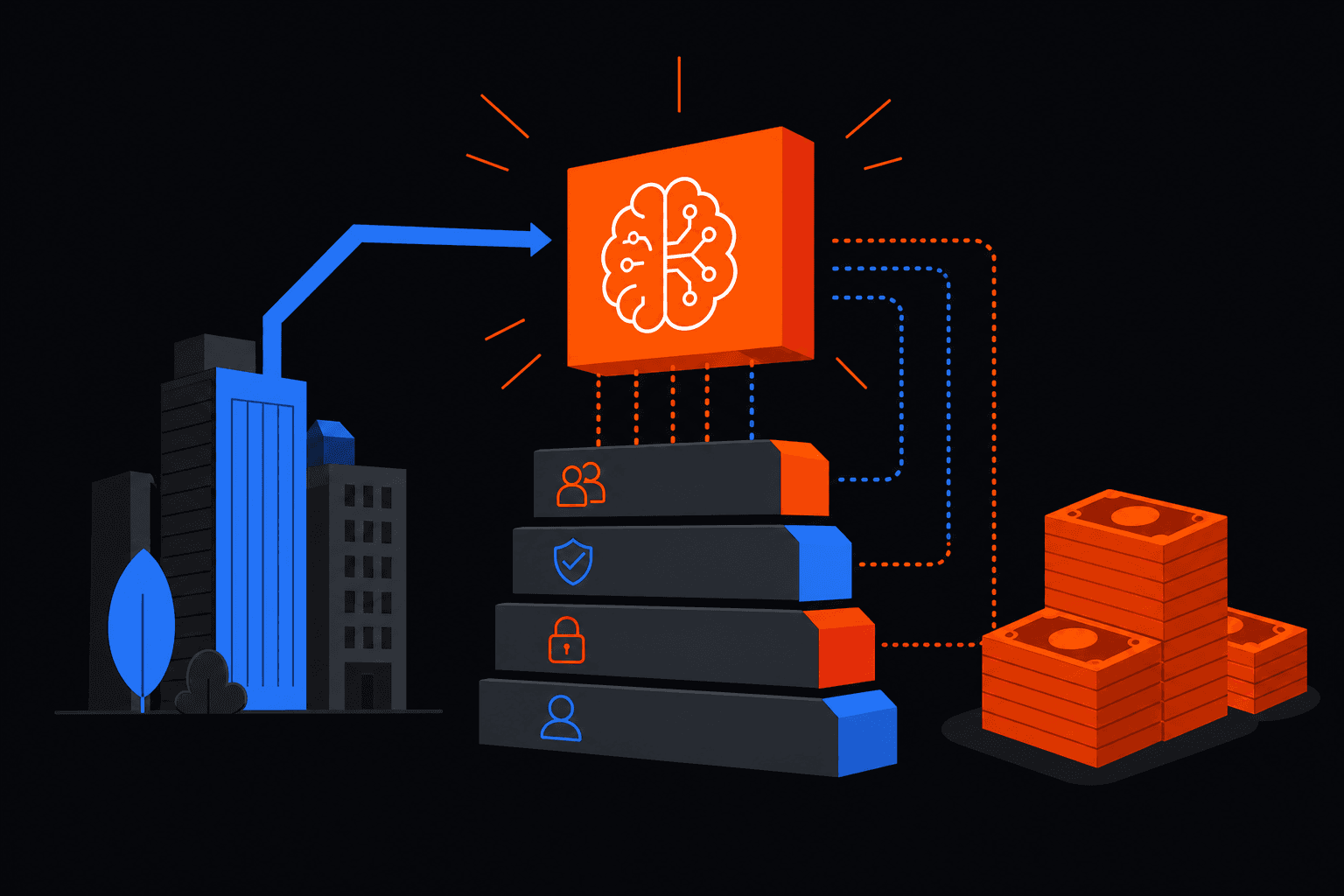
The four cost layers enterprises consistently undercount
1. Scope definition and rework
Most enterprise AI engagements start with a vague brief. That brief gets refined through discovery, which takes time and money. If discovery is billed separately, it adds to the headline cost. If it is bundled, it compresses the actual build time.
The more significant risk is rework. When the product that ships does not match the product that was approved, someone pays to close that gap. That cost rarely appears on the original invoice. It shows up in change orders, extended retainers, or internal engineering hours spent fixing what the vendor delivered.
Rework compounds faster in AI-native builds than in conventional development. AI-generated code can drift from the approved spec across multiple build cycles without a human reviewing each output against the original brief. The real cost of rework in enterprise software delivery is not a line item most vendors will surface for you.
2. Governance and oversight infrastructure
In 2026, governance is no longer optional. The EU AI Act is in force. Expanding federal guidance in the US and regulatory pressure across financial services, aviation, and telecoms mean that uncontrolled AI delivery carries legal exposure - not just operational risk.
Deloitte's 2026 research found that 74 percent of enterprises plan agentic AI deployment within two years, but only 21 percent have mature governance in place. That gap has a cost. Enterprises that ship AI-built systems without an audit trail, without documented sign-off gates, and without traceability from brief to production will spend money later to retrofit what they skipped at the start.
That retrofit is expensive. Compliance remediation after the fact costs significantly more than building governance into the delivery process from the beginning. The case for an AI governance control plane is a direct cost-avoidance argument, not an abstract one.
3. Vendor dependency and lock-in
Some AI development engagements are priced attractively at the start because the delivery model creates dependency. The code runs on proprietary infrastructure. The toolchain belongs to the vendor, not the client. Migrating away requires a rewrite.
This is not a hypothetical risk - it is a structural feature of certain engagement models. Thoughtworks operates a consulting-heavy model where the depth of the engagement creates ongoing dependency rather than a clean handoff. That is not necessarily wrong; some enterprises want a long-term partner. But the cost of that model is not just the invoice. It is the cost of not owning what you paid to build.
When evaluating AI development cost, the question is not only "what does it cost to build?" It is "what does it cost to own, operate, and exit?"
4. Internal capacity consumed
Every enterprise AI engagement requires something from the client side. At minimum, that is stakeholder time for reviews and approvals. At maximum, it is a dedicated internal engineering team to operate the vendor's tooling, manage integrations, and interpret outputs.
The second scenario is common with tool-based AI delivery models. The vendor provides the agent or the platform; the client provides the engineers to run it. That internal capacity has a cost, and it rarely appears in the vendor's proposal.
A done-for-you delivery model - where the vendor handles design, build, test, and deployment, and the client reviews outcomes rather than operating tools - shifts that cost back to the vendor. The client's time cost drops to feedback cycles, not operational overhead.
What enterprise AI development actually costs in 2026
Without published benchmarks from most vendors, the most useful framing is by engagement type.
Fixed-scope builds
A defined brief, a fixed price, a production-ready output. This is the cleanest commercial model for enterprises that know what they need. The risk is that scope creep or mid-engagement changes break the fixed-price logic. The benefit is budget certainty from day one.
Chatbot-focused AI development firms quote prototype-level work anywhere from $5,000 to $200,000-plus depending on complexity - but full-stack delivery from design through production deployment into the client's cloud is a different category entirely. Those figures are not useful benchmarks for enterprise-grade AI product delivery.
For a Fortune 1000 enterprise with compliance requirements, a production-grade AI application with proper governance, testing, and audit trail support sits in a different price band. The only honest answer is: request a scoped proposal.
Sprint-based engagements
Ongoing work billed per sprint suits enterprises with evolving requirements or a product that needs continuous iteration. The cost is predictable per sprint but open-ended in total. Without strong delivery governance, sprint-based models can drift - spend accumulates without clear progress toward a defined outcome.
Retainer models
Continuous development and support, billed monthly. This works well for enterprises that have shipped a first version and need ongoing capability without maintaining a full internal team. The cost is fixed, but the value depends entirely on throughput and quality of delivery.
The governance premium: why it is worth paying
A recurring question in enterprise AI development cost conversations is whether governance adds cost or reduces it. The answer is both - at different points in time.
Governance adds cost at the start. Named human sign-off at every release stage, a full audit trail, SOC 2 and ISO 27001 alignment, and documented traceability from brief to production all require process and time. That is not free.
Governance reduces cost over time. IBM's June 2026 research found that two-thirds of tech executives are responsible for AI systems they do not fully control, and only 11 percent say they are prepared for agent-scale deployment. The cost of that unpreparedness is not theoretical - it is compliance incidents, board-level questions, and engineering hours spent explaining what shipped and why.
Regulated industries face this most acutely. Financial services, healthcare, and aviation operate under audit requirements that make undocumented AI delivery a direct liability. The cost of uncontrolled AI delivery in regulated industries is a financial argument, not just a governance one.
How to evaluate what you are actually buying
When comparing AI development cost across vendors, these are the questions that separate headline price from total cost.
Who owns the code from day one? If the answer is not "the client," the exit cost is embedded in the engagement price but invisible until you try to leave.
What does the sign-off process look like? AI-agent-driven delivery without a human release gate means the system ships on the agent's judgment. That is an audit risk and a quality risk. Ask specifically: who is the named human accountable for what goes to production?
What does the client need to operate? If the delivery model requires the client to run tooling, manage integrations, or maintain the vendor's infrastructure, that internal cost needs to be added to the vendor's invoice.
What happens after delivery? A fixed-scope engagement that delivers clean, exportable, standard-stack code gives the client options. An engagement that delivers code running on proprietary infrastructure does not.
What governance artifacts are included? Audit trails, test coverage reports, security reviews, and documented release gates are not extras. They are the difference between a delivered product and a delivered product you can stand behind in a board review or a regulatory audit.
What a well-structured AI development engagement looks like
Tmob AI Studio's delivery model is built around the cost categories above. Enterprises submit a brief and receive a scoped, costed proposal within 24 hours. The build runs through five stages: spec and SLA, AI-agent-driven design and engineering, 24/7 automated testing, client feedback cycles via a Customer Portal, and a named Producer sign-off at every release gate before anything reaches production.
The code goes into the client's own repository from the first commit. The stack is standard and exportable. There is no vendor lock-in - the client owns what was built.
Security and compliance alignment covers SOC 2, ISO 27001, and GDPR. Client data is never used for training. A full audit trail is maintained across every release gate.
Commercial models are fixed-scope, sprint-based, and retainer. Pricing is scoped per engagement and returned in a proposal within one business day. No commitment is required to receive a proposal.
That track record runs 17 years and 300-plus delivered projects, including work for Mastercard, Vodafone, Turkish Airlines, Singapore Airlines, Shell, and Turkcell. The delivered products serve 250 million-plus daily users.
For enterprises trying to accelerate release cycles without sacrificing quality, the delivery model matters as much as the price. Throughput without governance is not a cost saving - it is a deferred cost.
What to do before your next vendor conversation
Before you enter a pricing conversation with any AI development vendor, get clear on three things.
What does "done" look like? A prototype, a production deployment, a fully tested and audited system? The answer changes the price band significantly.
What is your governance requirement? If your industry or your board requires audit trails, documented sign-off, and traceability, those need to be in scope from the start - not added later.
What does your exit look like? If you need to migrate, extend, or hand off to an internal team in two years, code ownership and stack portability matter more than the headline price.
Tmob AI Studio returns a scoped, costed proposal within 24 hours of a brief submission. No commitment is required. Start at tmobstudio.ai.