
Introduction
Most enterprises did not build their AI delivery governance for the scrutiny they now face. They built it for speed. That gap is now a compliance liability.
The question boards and regulators ask in 2026 is not whether your team used AI to build software. It is whether you can prove - with a documented software audit trail - who approved every decision, when it was made, and which human was accountable when something went wrong. For most AI delivery programs, that evidence does not exist in a form anyone can actually produce.
Why the audit question has changed
For years, software audit trails were primarily a financial controls concern. Sarbanes-Oxley required change logs. ISO 27001 alignment meant documented access controls. Regulated industries kept release records. None of that was easy, but the scope was manageable.
AI-driven delivery changes the scope entirely. When an AI agent writes code, proposes a design, generates test cases, or makes a routing decision, accountability becomes genuinely difficult to establish. Which human reviewed that output? What criteria governed the review? Did anyone with authority actually sign off, or did the output just flow through a pipeline unchallenged?
The EU AI Act's provisions, which came into full force for high-risk systems in August 2026, formalize what many regulators had already started demanding informally. Article 11-style documentation requirements mean enterprises deploying AI in high-risk categories must maintain technical documentation showing the system's design rationale, the human oversight mechanisms in place, and the records that prove those mechanisms actually operated. A pipeline that runs agents autonomously and deploys on their output alone does not satisfy that standard.
The market reflects this pressure. The enterprise AI governance and compliance market was valued at USD 2.2B in 2025 and is projected to reach USD 11.05B by 2036 at a 15.8% CAGR, with governance platforms holding a 48% share - driven specifically by demand for automated audit trail capability. Meanwhile, 93% of senior tech leaders report being worried about AI outputs they cannot see, according to Retool 2026. Boards are not the only ones paying attention.
What boards now want to see
Boards are asking different questions than they were 18 months ago. The shift is not philosophical. It is driven by personal liability.
A CTO or CIO who cannot answer "who approved the production release of this AI-generated feature, and what did they verify?" is exposed - not just to regulators, but to their own board, to auditors, and in financial services and insurance, to prudential supervisors who are increasingly treating AI governance as a material risk factor.
The specific artifacts boards now expect to see include:
- A record of who approved the original specification and when
- Evidence that testing was completed against defined criteria, not just "tests passed"
- A named individual who reviewed and signed off the production release
- Documentation that the system was deployed into a controlled environment, not a shared or vendor-operated one
- Confirmation that client data was not used to train or fine-tune any model
That last point matters more than most AI delivery vendors acknowledge. When a vendor's agents process your business requirements, your data models, and your customer logic, what that data trained is a legitimate compliance question. It is not paranoia.
Why most AI delivery pipelines cannot answer these questions
The problem is structural. Most AI-assisted delivery approaches were designed to remove friction from the build process. Audit trails add friction. So they were not built in.
Autonomous agent pipelines that write, test, and deploy code without a human sign-off gate create a documentation gap by design. The agent acted. No human approved. The log shows the agent's output, not a human's decision. That is not a software audit trail - it is a machine log.
Even teams using AI tools internally, where engineers review agent output, often lack the formal artifact structure that a regulator or auditor expects. A Slack thread where someone said "looks good" is not a release approval. A PR merged without a named reviewer on record is not a governance gate.
The gap between "we reviewed it" and "we can prove we reviewed it, here is the artifact" is where most enterprises are exposed right now.
What a defensible audit trail actually requires
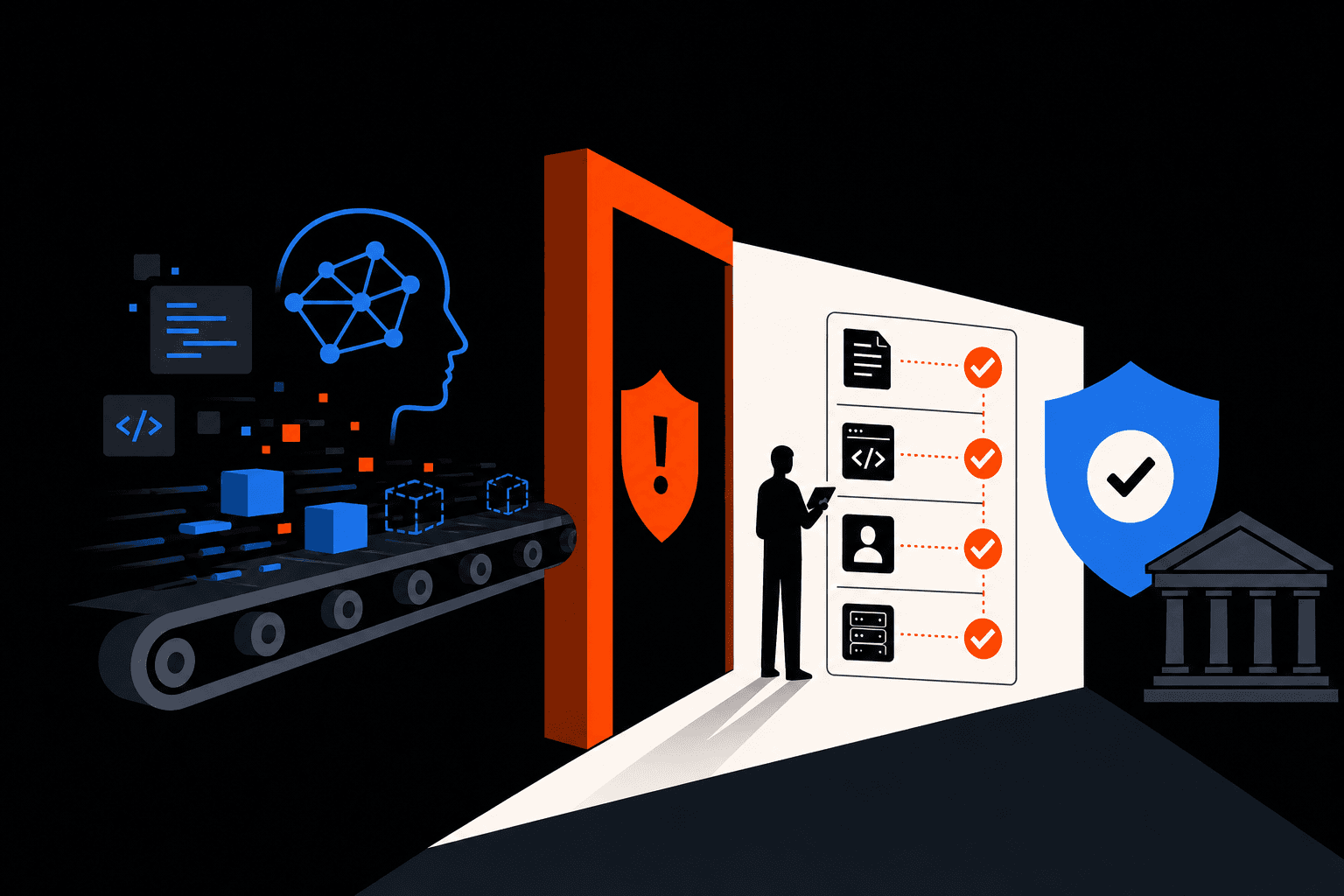
A software audit trail that satisfies board-level and regulatory scrutiny in 2026 needs to cover four distinct layers.
- Specification approval. The original brief, the scoped requirements, and the SLA must be documented and signed off before any build work begins. Scope changes need their own approval records.
- Build and test evidence. Every pull request, every test run, and every quality gate needs a record showing what was checked and what the outcome was. "Tests passed" is not enough. The record needs to show what tests ran, against what criteria, and who or what system verified the result.
- Human sign-off at release. This is the non-negotiable. A named individual with authority must review and approve the production release - not an automated check, not a pipeline status. A person, on record, who accepted accountability for what ships.
- Deployment environment documentation. Where the code runs matters. Deploying into the client's own cloud environment, under the client's own security controls, is materially different from deploying into a shared vendor environment. The audit record needs to reflect that the client controls the environment and that no vendor has standing access to production.
The separation-of-duties principle
Regulators and auditors use separation of duties to test whether a governance structure is real or cosmetic. The question is whether the person who builds something is the same person who approves it for production.
In AI delivery, this principle is under pressure. If an agent builds the code, an agent runs the tests, and the pipeline auto-deploys on green, there is no separation. The same automated system that produced the output also certified it. That is not governance - it is circular validation.
A genuine separation-of-duties gate requires a named human expert who did not build the feature to review it before it ships. That reviewer needs to be on record: the specific release they approved, the date, and the criteria they applied.
How Tmob AI Studio addresses this directly
Tmob AI Studio was built for exactly this operating environment. The delivery model is agentic, not autonomous. AI agents handle the volume of design, build, and test work around the clock - but nothing reaches production on an agent's say-so.
Every engagement runs through a documented five-stage loop. At the final stage, a named senior Tmob expert reviews the release and signs off before deployment. That sign-off is on record. The client can produce it. They can show who approved integration, what test coverage was verified, what security review was completed, and who authorized the production release.
The code deploys into the client's own cloud environment. The client owns the code from day one. Tmob AI Studio agents do not train on client data. The stack is standard and exportable - no vendor lock-in, no dependency on Tmob infrastructure to keep the system running.
For enterprises in financial services, insurance, aviation, and telecom, where audit exposure is not theoretical, that structure is not a feature. It is a prerequisite.
Tmob's delivery track record spans 17 years, more than 300 projects, and software now serving over 250 million daily users across clients including Mastercard, Vodafone, Turkish Airlines, Shell, and Halkbank. That experience shapes how every engagement is governed, not just how it is built.
The practical question for compliance-driven buyers
If your board asked for the software audit trail on your last AI-assisted release today, could you produce it within 24 hours? Not the code. Not the test results. The governance record: who approved what, when, and with what authority.
If the answer is uncertain, the risk is real. Regulators are not waiting for a major incident before they start asking. In financial services, these questions are already appearing in standard supervisory reviews - and that pattern is spreading to other regulated sectors.
The time to build the audit structure into your delivery model is before the question arrives, not after.
Learn more about how Tmob AI Studio structures delivery governance at tmobstudio.ai.